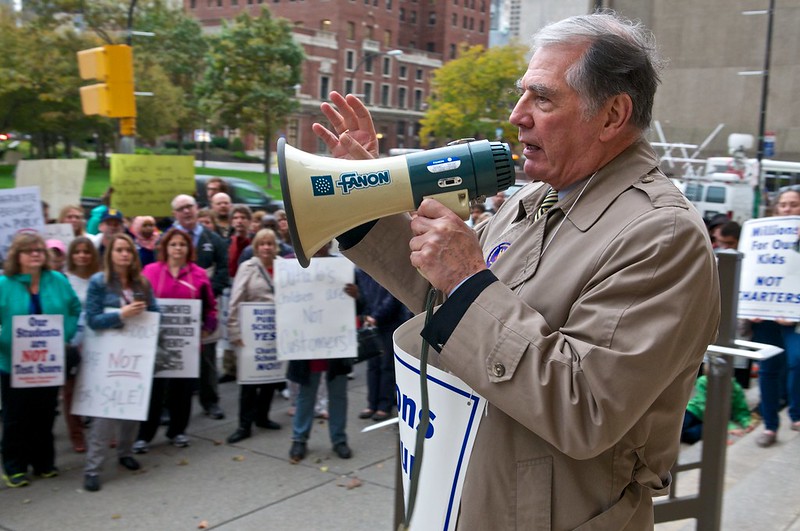
PJSTA Hosts Organizing Conference

Today the PJSTA hosted the Organizing for Power in a Post-Janus World conference at Terryville Elementary School. Dozens of local unionists and activists attended as we discussed, analyzed, and strategized organizing strategies.  Check out the inspiring messages from the conference’s guest speakers, MTA President Barbara Madeloni and REA President Angelina Cruz.

IMG_7715
Local unionists and activists
IMG_7710
PJSTA Members

PJSTA Resolution In Support of Striking West Virginia Teachers

The resolution below was passed by the PJSTA’s executive board today. All members are encouraged to click here and contribute to the strike fund.

Whereas the teachers and school service employees in West Virginia have been suffering under changes to their health insurance resulting in drastic increases to the premiums paid; and

Whereas West Virginia’s governor is only offering meager pay raises over the next five years that would not offset the health insurance increases; and

Whereas the combination of health care increases and meager pay raises would result in a “pay cut” of sorts; and

Whereas West Virginia already ranks 48th in the United States in teacher salaries; and

Whereas the treatment of an employer of it’s teachers and school service employees directly impacts the students and communities they serve; and

Whereas the teachers and school service employees in West Virginia have organized, largely at the grassroots level, a statewide strike that has completely shut down public schools across the entire state; and

Whereas the Janus v.s AFSCME case is being heard in the Supreme Court this week and the teachers and school service employees in West Virginia are showing us a path forward through grassroots organizing and militant direct action; and

Whereas the teachers and school service employees make up fellow affiliates of both the AFT and NEA; and

Whereas a victory for the teachers and school service employees in West Virginia would greatly encourage teachers everywhere, including members of the Port Jefferson Station Teachers Association and the New York State United Teachers, to continue in our increasingly stronger efforts to combat damaging and abusive cuts in New York; and

Whereas a victory for the teachers and school service employees would be a victory for public-sector employees across the country who continue to oppose the privatization of public resources and the plundering of public assets; therefore be it

Resolved that the Port Jefferson Station Teachers Association supports the teachers and school service employees in West Virginia in its fight for the needs of its members, their students, and their communities; and be it further

Resolved that the Port Jefferson Station Teachers Association will contribute to the strike fund for those on strike and encourage our membership to make individual contributions as well; and be it further

Resolved that the Port Jefferson Station Teachers Association urges NYSUT and its affiliates to adopt a similar resolution.

wv

Introducing PJSTA Live!

I am excited today to announce the launch of a project that I am pretty excited about… PJSTA Live!  PJSTA Live will be a regularly broadcast show on YouTube where we cover different angles of the public education and union landscape.  Our goal is to further engage our members, teachers outside of our local, and the broader public education and labor communities on the issues that impact us deeply.  We are hopeful that our viewers will not just use these shows as an opportunity to listen and learn, but also as discussion topics to raise within their own schools and education communities.

Episodes will typically feature one or more guests who will be participating in a discussion on a given topic.  Additionally, we will try to take questions from our millions  many viewers for our guests to answer.  Once the episode is recorded we will post it, along with any pertinent show notes, right here on our blog.  We will also link to all of our shows on our PJSTA Live page that can be accessed via the menu at the top of this page…

the-official-website-of-the-pjsta-the-pjsta-is-a-fair-trade-local

If you have questions for our guests you can ask them by filling out the embedded form on the PJSTA Live page.  You can also tweet at us using the hashtag #PJSTAlive.

Be sure to check back here at thepjsta.org later this week for news on our first broadcast!

Reminder to PJSTA Members: Wear Red Tomorrow!

Just a reminder to all PJSTA members to wear red tomorrow as a show of solidarity and support for our brothers and sisters in the CTU who will be on strike in the morning, barring a last minute settlement.  Last week we shared several other ways that you can show support.

Sister Michelle Gunderson on the need for a #FairContractNow …

For updates on the CTU strike be sure to follow them on Twitter.


PJSTA Resolution in Support of the CTU

ctusupport

Passed unanimously by the Port Jefferson Station Teachers Association’s executive board…


WHEREAS the Chicago Teachers Union has been negotiating since 2014 for a just contract, and

WHEREAS Chicago students and teachers have faced attacks on public education that mirror those in New York State and around the country, and

WHEREAS Mayor Rahm Emanuel has threatened to eliminate city pension contributions for CTU members, which would effectively cut their pay by 7 percent, and

WHEREAS the CTU engaged in a successful strike in 2012, joining with parents, students, and communities to fight for educational justice and the schools Chicago’s students deserve, and

WHEREAS on September 28th, 95.6% of Chicago teachers voted to authorize a strike, and

WHEREAS, CTU has released a report, titled “A Just Chicago: Fighting for the City Our Students Deserve”, which, as the union puts it “demonstrates that challenges in housing, employment, justice and health care relate directly to education; solutions require a narrowing of the opportunity gap brought on by poverty, racism and segregation,” making CTU’s fight for a contract a touchstone for a wider struggle against austerity and for economic and racial justice, therefore be it

RESOLVED that the Port Jefferson Station Teachers Association supports the CTU in its fight to negotiate a contract that meets the needs of its members, their students, and their communities, and be it further

RESOLVED that the PJSTA will launch a solidarity campaign, to be shared via social media, in its schools and encourage all of its members to participate in the campaign as a show of support and solidarity with our sisters and brothers in Chicago, and be it further

RESOLVED that the PJSTA will urge its entire membership to wear red on Tuesday, October 11th in a show of solidarity with our brothers and sisters in the CTU, and be it further

RESOLVED that the PJSTA contribute to the CTU’s solidarity fund when information for such fund becomes available, and be it further

RESOLVED that the PJSTA share information with its general membership on how to contribute to the solidarity fund and urge each of its members to contribute individually as well, and be it further

RESOLVED that the PJSTA executive board engage the general membership in discussions on the strike, informing them of the issues involved and drawing parallels to the similar situations that impact educators in New York, and be it further

RESOLVED that the Port Jefferson Station Teachers Association urges NYSUT and its affiliates to adopt a similar resolution.

Summer Musings Part II- Examining Our Union Structures

empowering_teachers

Last week I published my “Summer Musings Part I” post in which I posed a number of questions…

As I begin to wrap my head around the idea of the 2016-2017 school year, I do so with the question in mind of how do we raise teacher voice across New York State and beyond?  How do we empower our members at the very grassroots level?  How do we better engage our membership at the local, state, and national levels in a way that allows the members to drive the union agendas?  How do we create union cultures that encourage membership participation and what exactly does that participation look like?  How do we create times and places to facilitate discussions among the rank and file about what our unions are vs. what they actually should be?  How do we build more democratic unions and how do we overcome the obstacles that stand in the path of union democracy?  How do we turn our unions from passive unions or unions who simply mobilize around top down mandates into unions who have rank and file organizing at the very heart of their operation?

Like our many readers assuredly have (haha), I’ve been giving a good deal of thought to those questions over the past week or so.  Several of those questions tend to overlap with each other, so I am not necessarily going to write to each of those questions, but more share some of the thoughts that have been running through my head as I ponder those questions.

One concept that I keep coming back to is the concept of union structures.  It seems to me that the structures of our unions, in many cases, are prohibitive to what a union’s goals should be.

An empowered rank and file should ultimately be the result of of a membership who has had ample opportunity to engage with one another and with union leadership on what their shared values are and on what they expect from their union in regards to those values.  These opportunities for engagement should be frequent, whether they be causal or formal meetings, and should allow for deep and meaningful thought and discussion from all parties.  They should allow for participants to ponder the causes of issues that effect our schools and communities along with the long term implications of these issues or potential plans of action.  Meetings such as these, with no dominant voice, rather a respectful exchange of ideas from all participants, allow all members to have a greater role.  They allow the union to move forward as a collective, organized around a set of shared values, rather than as a leadership pulling a membership along.

In smaller locals like ours it is more common to witness these sorts of structures.  While the PJSTA certainly isn’t structured like my ideal scenario above, we do have regular building meetings where members are free to express concerns and share opinions.  Our leadership is in the schools every day, not only available to have personal and informal conversations with the membership, but in the trenches teaching with the same working conditions that our members are.  As a vice-president who is largely tasked with coordinating our local’s organizing endeavors, it is my personal goal to move us more in the direction of my stated ideal above.

Often where structures really start to become problematic are in larger locals, like the ones often found in cities, and in our statewide and national unions.  The larger the union, it seems, the more problematic we find the union structures.  Let’s take NYSUT, our statewide union, as an example.  I am wracking my brain and I can’t, for the life of me, recall a time that NYSUT asked me, as a rank and file member, what issues were important to me.  I can’t recall a time where they have provided space for in depth discussion between members on the issues that we face or on more philosophical ideas about how our union should function.  Virtually all of my interaction with NYSUT throughout my 14 years as a member has been different varieties of one-way communication.  I have received mandates from the leadership on what I should fax or email, what I should say to my elected officials, who I should vote for, or scripts I should read to others on the phone.  This is literally the opposite of empowering.  Rather it sends the message to me as a member that my ideas and opinions are inconsequential and that engaging me isn’t important.  I simply exist as a tool to do the bidding of our leadership.

In January I emailed NYSUT President Karen Magee with questions along these lines and I was basically told it was none of my business.  There have been very few times in my career when a NYSUT officer has visited our local and when they have it was never to engage the membership, only to talk at them and then usually ask for an increase in VOTE-COPE contributions.

When I attend the RA as a delegate most of the discussion centers around resolutions brought to the floor.  Precious little debate takes place before a Unity Caucus member typically calls the question to shut down discussion and then the motion is voted on.  If you are not first on line (out of more than 2,000 delegates) at a microphone to speak, it usually means you don’t get to speak.  In general the resolutions are fairly meaningless to the general membership anyway (Quick, count how many NYSUT resolutions have impacted you in the classroom?  I bet you can count them on one hand!)  The rest of the RA typically consists of the VOTE-COPE guy asking us to give more VOTE-COPE, and maybe a candidate our leadership is pushing who talks at us (this year it was Hillary Clinton).

I can go on and on about the issues I have with NYSUT, but I don’t think that’s necessary.  Clearly NYSUT is very top down in nature and it’s entire structure stifles discussion about the issues that effect us and does more to encourage members to disengage than it does to empower them.  The same can be said about the AFT on the national level.

What I find to be most appalling is that these sorts of structures typically tend to be by design.  I don’t believe that the leaders of NYSUT and the AFT are necessarily interested in hearing from the membership.  I don’t believe that they are actively seeking out ways to empower and engage the rank and file.  I don’t think that they have any interest in establishing rules that make our unions more democratic.  To do any of these things would be to put themselves and the power that they have accrued at risk.  It would endanger their seat at the table.  To be honest, there are not many people who would want to give up salaries of hundreds of thousands of dollars, expense accounts, double pensions, and seats at national conventions.  The bigger problem is the structures that are put in place allowing these leaders to run our unions as they do for an indefinite period of time without having to answer to the membership in a meaningful way.  When you allow those in power to make the rules and create the structures, these are the sorts of situations you find yourself in.

There are no easy solutions to this problem and there are no shortcuts.  Electing new leadership (virtually impossible in NYSUT because of the elections rigged in favor of whomever Unity Caucus endorses) isn’t a real solution due to the likelihood of new leaders falling into the same traps as previous ones due to the fact that they are operating within the same flawed structure.  Any structure that relies upon humans resisting the temptation to be bought off is likely doomed to fail.

In June I was sitting in a meeting with members of other locals and the topic of our flawed leadership came up.  How they haven’t done enough to help us in regards to certain issues. While I agree to an extent, I don’t find the individual leaders to be the problem.  It isn’t Karen Magee, Andy Pallotta, or Mike Mulgrew.  It’s the union structure that has allowed it to happen.  You can plug in virtually anyone and get very similar results.  Which is why the answer is not changing leadership.

I firmly believe that the answer to the problem of our union structures begins in our schools at the worksite.  It starts with building new structures within our buildings and locals that are more democratic in nature and that empower our membership.  When we create organizing unions that emphasize democracy and teacher empowerment we create an extremely powerful union and the leadership ultimately doesn’t matter.  It isn’t easy and it isn’t glamorous and it is often tedious.  But it is the most important work that a union can do.  If this sort of work were done extensively statewide, our statewide union would ultimately change.

So join me this year in working to reshape your unions.  We’ll be working on ways to better engage members in deeper discussions, identify shared values, and empower members.  Feel free, as always, to share your ideas with us!

A Conference You Won’t Want to Miss

I want to quickly share with our readers and wholeheartedly endorse the upcoming 2016 Labor Notes Conference.  The conference, being held in Chicago from April 1-3, brings together grassroots unionists from around the country to discuss common issues and strategize ways to build grassroots unionism.

I personally know several of the teachers who will be there and consider them among the most passionate and dedicated teacher unionists I have ever known.  It is my great hope that several of the Stronger Together Caucus leaders will be in attendance to network with other like minded caucuses from around the country.  You can click the above link to get more information and to register for the conference.

conference20ad1

Public Sector Unions Poised to Escape Friedrichs Case Following Scalia’s Death

It was literally moments after the news of Justice Antonin Scalia’s unexpected death that people started to react to what the consequences would be.  Included among them would be the outcome of the Friedrichs vs. California case that threatened to be a tremendous blow to public sector unions.  Scalia was expected to be among the majority who would rule against unions in a 5-4 vote.  The decision, in essence, would make the payment of union dues optional, while unions were still obligated to collectively bargain for those workers who were refusing to pay dues.  Now, with Scalia’s death and the expectation that the GOP majority in the U.S. Senate will block any candidate who President Obama nominates as a replacement, the case will almost certainly have a 4-4 vote.  In that case the decision of the lower court, which benefited the unions, will be upheld.

Via thing Progress

Public sector unions are saved, at least for now. After oral arguments in Friedrichs v. California Teachers Association, it appeared likely that an ambitious effort to defund public sector unions would gain five votes on the Supreme Court. Now this effort only has four votes. Moreover, because the plaintiffs in this case lost in the court below, a decision affirming the lower court in an evenly divided vote is effectively a victory for organized workers.

Ironically, the plaintiff in the case, California teacher Rebecca Friedrichs, had asked for the lower district court and court of appeals to rule against her quickly, without trial or oral argument, in order to move the case along to the Supreme Court more expeditiously.

I’m sure we will get into more detail in the coming weeks about the case’s deeper implications for our members and teachers across the country.

Some Union News

Phil Rumore won re-election in Buffalo.

Some interesting teacher union tidbits coming in this week…

  • One of the largest NYSUT locals, the Buffalo Teachers Federation, concluded a contested election for it’s leadership.  President Phil Rumore, won re-election with 707 votes.  Challengers Pat Foster and Marc Bruno had 344 and 299 votes respectively.  What is interesting is that Rumore had about 52% of the vote.  Had he not received 51% or more a runoff would have been forced between he and Foster.  Had Bruno supporters decided to back the other challenger in Foster there could have been a real threat to Rumore.  Some rumors suggest Rumore would have retired rather than try to win in the runoff.
  • While Rumore has shown to be a Unity Caucus supporter at the state level, Stronger Together member Kevin Gibson won re-election on the BTF’s executive committee.  He was joined by Teresa Leatherbarrow, a member of the same Renew slate that Gibson ran on, and Sean Crowley, writer of the always entertaining B-LoEdScene blog.  How this election impacts things at the NYSUT and AFT levels remains to be seen.
  • Out in Hawaii, a slate of opposition candidates called Hawaii Teachers for Change challenged for the leadership of their statewide union.  After they won the president and secretary treasurer seats, the incumbents voted not to certify the election yet have failed to provide any reason for doing so, other than citing “irregularities.”  It’s the old “If you lose, just keep having elections until you win!” trick.  Norm Scott says that it reminds him of the UFT circa 1985.
  • The above mentioned Scott and Mike Schirtzer, both of MORE, held a debate in a Manhattan diner over whether or not it was worth it for MORE to run a slate of candidates in the 2016 UFT elections.  My favorite part was also James Eterno’s…

via ICEUFT Blog

It was a healthy exchange of ideas but the best part of the evening for me was passing the application sheets around and having almost everyone there fill out the form and pay the fee to join the new statewide opposition to Michael Mulgrew’s Unity Caucus called Stronger Together.