MaryEllen Elia Launches Attack on Buffalo Teachers

Via the Buffalo News…

In one of her most significant actions as state education commissioner, MaryEllen Elia has granted Buffalo Superintendent Kriner Cash unprecedented power to make changes at the district’s most struggling schools, bypassing the teachers union contract.

Those changes could include a longer school day and year, required teacher training and more control over staffing – all things Cash says are essential to improve student performance.

“Students at these persistently struggling schools need help right now,” Elia wrote in a statement. “The receivership law gives the superintendent enhanced authority in order to maintain local control while facilitating rapid improvement in student outcomes. This receivership collective bargaining agreement will, among other things, enable Dr. Cash to more effectively utilize and deploy effective teachers and make changes to programs and teaching assignments – all of which will ensure that students in these struggling schools are provided with  Teachers can be  increased educational opportunities.”

This is very clear evidence for where corporate ed reformers are seeking to drive their agenda.  Use rigged standardized test scores to declare schools to be “struggling,” those schools are placed in receivership.  The state then steps in and bypasses the teachers’ contract.  Teachers can be replaced on a whim, their working conditions arbitrarily changed even though there is no evidence such changes improve student learning.

I am hoping the events in Buffalo are the impetus for mass organizing by NYSUT or, at the very least, STCaucus.  Without the rank and file organizing at the general membership level New York’s teachers will continue to be unprepared to take the collective action necessary to defeat an agenda such as the one we face now.  A commenter on the Perdido Street School Blog’s post on this story had this accurate comment regarding potential statewide action (emphasis is mine)…

A ten day strike in 2006 nearly destroyed the Transit Workers Union in NYC–dues checkoff pulled for two years (yes, I know, Friedrichs might take care of that for us on its own), members fined two days pay for each day on strike (though this was mitigated by the judge) and Roger Toussaint in jail for three days (yes, we all might like to see Mighty Mike in an orange jumpsuit). Huge public backlash against the Transit Workers.

I’m retired so have no position about a strike, personally. But there needs to be a great deal of prep work done with rank-and-file if anyone expects that a strike resolution would pass in any local. Calling for a strike may be useful talk resulting in positive action–or not–but it’s not a matter to be thrown out there as casual conversation without a deep understand for the consequences.

We have members who don’t vote in union elections. We have an executive board controlled by the Unity Politboro. We have a public that might not be inclined to support a teachers strike and public support, or at least acquiescence, is important if we were to violate the Taylor Law.

All I’m asking is that folks talk about a “strike” intelligently, knowing just how difficult it would be to organize, explain to members, maintain and what the probable consequences would be.

Only then, pick up the pickets signs and walk out the door….

Click here to read the PJSTA’s resolution in opposition to receivership that the executive board passed last month.

PJSTA Members Speak Out at Common Core Task Force Hearing

Three PJSTA members spoke at today’s hearing with the Common Core Task Force at Stony Brook University.

Melissa McMullan can be seen speaking here.

Beth Dimino follows Jeanette Deutermann here.

Brian St. Pierre can be seen in the video embedded below.  Thank you for the many PJSTA members who were in attendance in support of our schools, our students, our teachers, and our community!

Deep Organizing v. Shallow Mobilizing… Be the Union!

What looks good on a button would look better put into action.

Editor’s Note: I originally had a version of this story was originally published in the Fall 2015 issue of The Portal, the PJSTA’s newsletter.

Within union circles it is often popular to hear the union leaders encourage membership mobilization with the phrase “You are the union!”  The idea, of course is that the general membership is the engine that drives the union, informing leadership of the directions it should be taking and that everyone plays a crucial role in their union.  Theoretically there is certainly nothing wrong with this idea.  It’s actually the way a union really should run.  Unfortunately, to the leadership of our parent unions this often seems more like a gimmicky phrase than a guiding philosophy.  It looks good on a button but when it comes to how NYSUT, the AFT, and the NEA operate the philosophy is quite clearly one where the leadership send out top down mandates for the membership to carry out.

At the crux of this issue is what should be the most important task of any union worth it’s salt, the task of organizing.   Organizing should be one of the pillars of all union work.  However what we more typically see are unions mobilizing around issues by simply directing membership towards carrying out a task, often one that is mindless in nature.  Sending a fax or email by simply clicking a button for example.  Or calling an elected representative and reading a scripted message.  It requires almost no engagement from membership, simply a few moments out of their busy lives to carry out a directive.  This is a strategy that has failed us greatly as we find the entire institution of public education in great peril.   The issue of deep organizing vs. shallow mobilizing is one that unions at every level need to examine with a reflective eye towards how they operate.

Kelley Collings, a member of the Philadelphia Federation of Teachers and an active member of the Caucus of Working Educators within the PFT, recently wrote an article on the Caucus of WE’s website titled, “What Deep Organizing Looks Like: The Real Work-to-Rule Campaign”.  The article, which was a critique of the PFT’s fairly weak efforts to mobilize its members, had a great description about deep organizing vs. shallow mobilizing tucked into it.  Let’s be clear on the difference between deep organizing and shallow mobilizing.  Deep organizing makes us stronger as a union.  Deep organizing demands that we have solid relationships with each other as PFT members.  Deep organizing requires that we develop authentic power-sharing partnerships with parents and community members as we fight for the resources our students and school deserve. The Caucus of Working Educators is committed to deep organizing that leads to effective direct actions. Anything less than that does a disservice to our students and our schools.  

Collings suggestion boils down to a few key points.  Union members should be developing trusting relationships with each other, with the parents of their students, and with their school communities to plan direct actions that aid in our fight for the schools our students deserve.

The deep organizing mentioned here is hard, time consuming work.  Often times the direct actions planned take weeks, if not months to organize and put into action.  Most of all it requires leadership to trust their members and relent some of their much valued control over the activist work that it’s membership is doing.  Having said all that, it is literally the only way that we will be saved from the path of destruction that public educators have been marched down for several years now.  

All of the phone calls, emails, and visits to state legislators have mostly fallen upon deaf ears.  The enormous amounts of VOTE-COPE money that NYSUT has collected and doled out to elected officials has had little to any positive impact on teachers as politicians have taken the money with one hand and voted for harmful education reforms with the other.  So the easy mobilizing solutions of clicking a button to send a fax, sending money to VOTE-COPE, or reading scripted messages have proven to be fruitless.  So let’s talk about what deep organizing looks like at the local level.

Deep organizing begins with the irreplaceable task of being informed on the issues that face our profession and impact our lives and the lives of our students every day.  This is a vast ocean of information and certainly not one in which anybody can claim to know everything about.  Some issues are as general as poverty and some as nuanced as democratic structures (or lack thereof) within our unions.  While it is unrealistic to expect every teacher to run out and become highly informed on all of these issues at once, it is very realistic to expect that every teacher is willing to devote some time every day to becoming informed on some of these issues.  This is, after all, our livelihood.

There are several ways to become informed.  One of the simplest ways is to pick a respected blog and begin checking it daily.  Many good blogs are updated at least five times a week.  The average one of these blog posts likely takes an adult less than five minutes to read.  Read one over your first sips of coffee in the morning each day and your level of knowledge of the issues will expand greatly in no time.  Another way of getting and staying informed is via Facebook and Twitter where you can follow a steady stream of information pertaining to the important issues.  Use these mediums simply as a stream of information or jump in and become part of the discussion, using the social media to banter, debate, and question the issues with other participants.  If you are a more traditional reader who enjoys reading books, there are a plethora of options out there.  Reign of Error by Diane Ravitch, This is Not a Test by Jose Luis Vilson, and Strike for America by Micah Uetricht are just a few titles that deal with the issues that are prevalent in our profession.  Read one on your own or create a book club with friends or colleagues.  Finally, interact with your colleagues.  Discuss these issues with teachers in the faculty rooms at lunch, happy hours after work, or in a walk out to the parking lot.  Share opinions and ask questions.  Help educate and inform each other on our mutual struggle.
Being informed is the all important first step to take.  In my experience, an informed teacher is naturally driven to begin the deep organizing that is required of us.  You won’t need a list of talking points to interact with parents about the abusive reforms being foisted upon their children and you won’t need union leaders requesting you to “take action” as your professional conscience will be driving you in that direction already.  Teachers are a smart, passionate, creative, and resourceful bunch.  We have everything we need to combat the assaults on public education within our ranks.  Decide how you will go about the task of deep organizing.  Consider what actions you will take to become a part of the solution.  You are the union.

Listed below is an incomplete list of some of my favorite blogs that I read regularly…

MORE Announces Jia Lee Will Oppose Michael Mulgrew in 2016 UFT Election

Beth Dimino, Jia Lee, Brian St. Pierre.  Lee will be running against Michael Mulgrew for UFT President.
Beth Dimino, Jia Lee, Brian St. Pierre. Lee will be running against Michael Mulgrew for UFT President.

Jia Lee, the well known teacher activist from New York City who was the guest speaker at the 2015 PJSTA Conference Day, will be running in opposition to Michael Mulgrew for president of the United Federation of Teachers in this spring 2016 UFT election.

Mulgrew, whose position as the president of the largest local in the country, makes him the most influential teacher unionist in the country, in regards to influencing the direction of our statewide and national unions.  He famously defended the Common Core at the 2014 AFT Convention by threatening anyone who “took them away” from him with violence.  Additionally he marched with Governor Cuomo during the 2014 Labor Day Parade.

Lee’s record shows her to be quite a different candidate than Mulgrew.  A current special education teacher, Lee has been one of the most visible opponents of high stakes testing in the state.  She has worked diligently to build the opt-out movement in New York City and has traveled to other parts of the state as well to help the movement in those regions.  She spoke at a Students Not Scores event in Port Jefferson last spring.  Lee is also the face of the conscientious objector movement as she has refused to administer the New York State tests the past two years and helped to pen the Teachers of Conscience position paper.  Lee, a member of the MORE Caucus within the UFT will be at the head of a joint slate put forth by MORE and New Action.  At the statewide level, Lee is a member of the Stronger Together Caucus.

Via MORE Caucus

NEW YORK: Educators, parents, and community members cheered the announcement of Jia Lee as their choice for UFT presidential nominee at the State of Our Union, State of Our Schools Conference on Saturday. Fed up with overcrowding, underfunding, and overtesting, educators are coming together with the community to take back their union, and bring change to their schools through the 2016 UFT elections.

“Our schools are in crisis, in large part part because our current union leadership is complicit in bad policy and continues to tell us that this is the best they can do. It’s not the time for us to re-negotiate what has already proven to be disastrous. It’s time for teachers to come together with the community and chart a new course for our union. We are going to take back our union and lead a fight for the schools our children deserve,” said Ms. Lee.

Saturday’s conference, organized by the Movement of Rank and File Educators (MORE) in coalition with a host of community organizations, was the first step in defining a platform for the upcoming UFT election and 2018 contract negotiations to defend and enhance New York City’s public schools. The conference  featured discussions ranging from “Bringing Democracy to the UFT” to “Making Black Lives Matter in Education.”

In the upcoming UFT election, Lee will head a joint slate of teachers representing a united front of MORE and the New Action caucus. As a parent and a teacher since 2001, Jia Lee is at the forefront of the growing movement to opt-out of high stakes testing. She has served as a UFT Chapter Leader for the past 8 years, and is a conscientious objector who has steadfastly refused to administer tests that reduce her students to test score. Last year, she brought this testimony to theU.S. senate hearing on ESEA.

Educators have lost patience with Michael Mulgrew and the Unity caucus’ leadership of the United Federation of Teachers and are joining the community to continue building a movement for change– in their union and in our schools. Mulgrew has been president of the UFT since 2009 but has been unable and unwilling to effectively challenge the corporate onslaught against public education. He has agreed to high stakes-test based teacher evaluations and a contract that delayed earned pay raises for teachers.

In the last union election, in which 75% of working educators did not vote and the majority of ballots came from retirees, the MORE caucus earned 40% of the vote in the high school division and 23% of the active teacher vote overall. This year, in partnership with the New Action caucus, MORE seeks to increase voter turnout as active teachers reclaim their union.

ABOUT MORE: The Movement of Rank-and-File Educators (MORE), is the social justice caucus of the UFT and largest force for change within the teachers union. In the upcoming elections, MORE has formed a united front with New Action Caucus  to challenge Unity Caucus, the bureaucratic political machine that has dominated New York’s teachers’ union for the past 50 years. Over the past decade, Unity has led the UFT into crisis, signing off on harmful policies such as overuse of standardized testing and pay increases that fail to keep pace with inflation, while using union funds to pay UFT President Michael Mulgrew over $260,000 per year and dole out salaries of over $100,000 per year to over 100 Unity Caucus political operatives on UFT staff.

###

The Movement of Rank and File Educators is the Social Justice Caucus of the United Federation of Teachers.  To learn MORE, visit www.morecaucusnyc.org

Lee’s keynote at this weekend’s MORE Caucus Conference…

PJSTA Resolution in Opposition to Receivership

Yesterday, thePJSTA Executive Board unanimously passed the following resolution…

Resolution in Opposition to Receivership

WHEREAS: New York law establishes Receivership for schools that have been or will be categorized as persistently failing and struggling and that these schools are identified as the schools in the lowest 5% state-wide on NY Common Core assessments will mean there will always be failing schools and schools in Receivership, and;

WHEREAS: Receivership uses developmentally inappropriate and unreliable Common Core aligned test and punish and evaluation regimes to categorize failing schools, and;

WHEREAS: The Port Jefferson Station Teachers Association has taken a strong position against the Common Core Standards, and encourages members to refuse the Common Core Tests used to place schools in Receivership, and;

WHEREAS:  144 public schools serving mostly low income students from Buffalo to Albany, Utica to New York City, Yonkers to Rochester have fallen into Receivership, and;

WHEREAS: Receivership law states that the Receiver “may abolish the positions of all teachers and pedagogical support staff, administrators and pupil personnel service providers”  of any or all Receivership schools and can do so without cause, and require them to reapply if they choose, and;

WHEREAS: Receivership requires a “Staffing Committee” to determine whether senior former staff at Receivership schools are qualified to return to the school and those who are not rehired from their school are denied “bumping/seniority rights” and must be placed on a preferred eligibility list regardless of their teaching experience, and;

WHEREAS: Receivership further undermines collective bargaining by granting a Receiver broad power over budget, curriculum and programs, discipline, testing, class size, teaching conditions, length of the school day and year for each individual Receivership school, and;

WHEREAS:  Receivership erodes local control of schools by allowing a superintendent or independent Receiver to supersede decisions and policies established by an elected Board of Education, and;

WHEREAS: The Port Jefferson Station Teachers Association has previously stated both its opposition to Receivership and its support of local control of Public Schools, and;

WHEREAS: Receivership denies due process and other forms of fair employment practices for educators and administrators by allowing the law and commissioner’s regulations to set up a timeframe and process for different agreements with each Receivership school that ensures these “agreements” give expression to the will of the commissioner without ever having to prove how imposed agreements will improve the quality of education, and;
WHEREAS: Receivership law requires “failing/struggling” schools to improve in two years but provides ZERO/NO additional resources or funding to those schools, and;

WHEREAS: Receivership does not address the great inequality in funding for urban schools, as the Tax Cap and GEA have helped to defund New York State’s Public Schools since 2010, but rather Receivership doubles down on those districts by defunding them year after year, labeling them failures and giving them one or two years to “improve” without additional resources in most cases.
———————————————————————————————————-
THEREFORE BE IT RESOLVED IN UNITY: That The Port Jefferson Station Teachers Association vigorously oppose Receivership and encourage our regional and statewide NYSUT affiliates to pass similar resolutions demonstrating solidarity against New York Receivership law, and;

BE IT FURTHER RESOLVED:  that NYSUT exhaust all legal means to change and to challenge in court any attacks on due process, collective bargaining and other fair labor practices that are a consequence of Receivership, and;
BE IT FURTHER RESOLVED: that NYSUT develop a plan/outline to advise members on how they should respond to the demands of Receivership and that NYSUT plan meetings to educate and activate members about said plan – especially those in Receivership schools who develop a SIP plan, sit on a Staffing Committee, or are assigned to CET, SBMT and/or any other member interested in the impacts of Receivership, and;

BE IT FURTHER RESOLVED: that The Port Jefferson Station Teachers Association will submit a Resolution in Opposition to Receivership at the April 2016 NYSUT RA in Rochester NY, and;

BE IT FURTHER RESOLVED: that a copy of this resolution be sent to all NYSUT Members and all local NYSUT Presidents and the entire New York delegation in the State Legislature.

On the NEA Clinton Endorsement

Over at Mike Antonucci’s EIA blog, he has the break down of the NEA voting regarding the early Clinton endorsement.  Pretty interesting to look at.

Via eiaonline.com

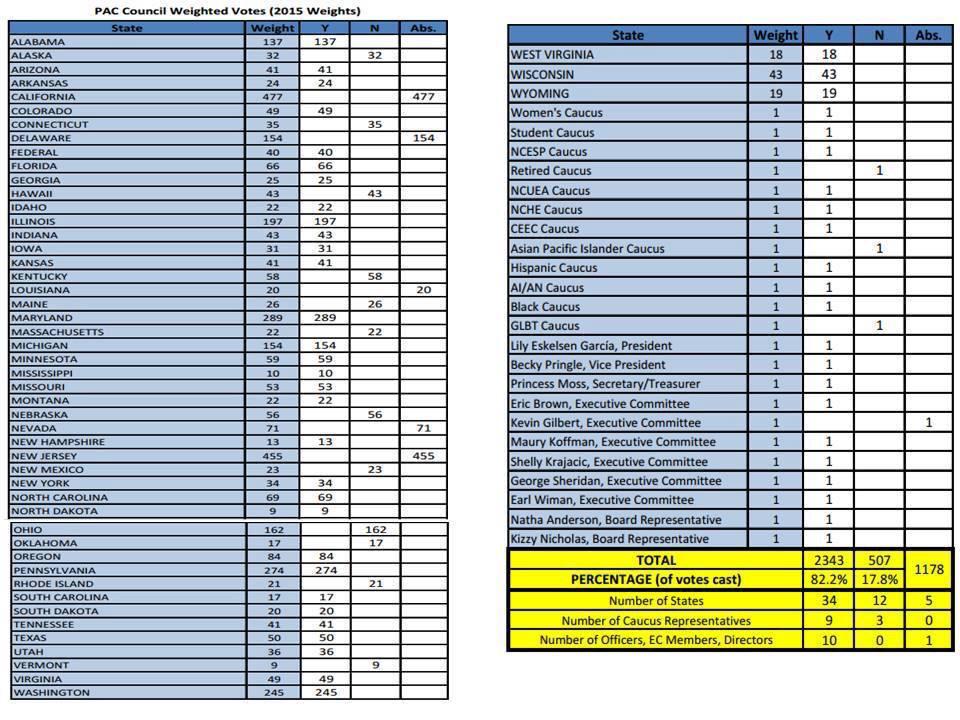
NEA PAC Council Vote by State – Abstentions Critical

WRITTEN BY: MIKE ANTONUCCI – OCT• 04•15

The vote on Thursday by the NEA PAC Council to endorse Hillary Clinton required a simple majority, and was reported to be 82% in favor. But now we have the roll call vote by state and caucus, and things aren’t so simple.

Each state’s votes are weighted by the amount they contribute to the PAC, plus each major NEA caucus gets a single vote, as well as the Executive Committee members and two members of the Board of Directors. There are 4,028 votes in total. You may have to zoom in to see the tally, but there are a few curious results.

First, one executive committee member, Kevin Gilbert of Mississippi, abstained. That’s already unusual, since the Executive Committee generally votes in lockstep on important issues.

The caucuses that voted no were the Retired Caucus, the Asian Pacific Islander Caucus and the GLBT Caucus.

The states voting no were Alaska, Connecticut, Hawaii, Kentucky, Maine, Massachusetts, Nebraska, New Mexico, Ohio, Oklahoma, Rhode Island and Vermont.

The big mystery is why five states abstained, including the two largest, California and New Jersey (the others were Delaware, Louisiana and Nevada). New Jersey was especially vocal about not supporting an early Hillary endorsement.

If all the abstentions had been “no” votes, the simple majority would still have been reached, but the margin would have been reduced to 58.17%.

You saw the uproar that occurred on Friday and Saturday. Imagine the pressure on the board of directors – which required a 58% majority to endorse – if NEA’s Sanders supporters felt they were that close to defeating it.

It was close even if you just look at state affiliates plus the Federal Education Association – 34 in favor, 17 against or abstained. That’s still close enough to prompt internal lobbying and at worst reduce Clinton’s margin of victory to the low 60s, which would have greatly diminished the triumphant tones we heard yesterday.

What’s next? NEA conducted its orchestra with skill and got what it wanted: the authorization to spend dues and PAC money promoting Hillary’s candidacy. Whether that will turn out to be a Pyrrhic victory is entirely up to what the dissidents do next. An NBI ain’t gonna cut it.

A few things to note…

  • All of the NYSUT reps (all of whom are Unity Caucus members) votes in favor of the Clinton endorsement.
  • As Antonucci mentioned, the big issue with this endorsement is not so much the endorsement as it is the dues money and PAC money that comes attached to it.  This endorsement was top down unionism at it’s most basic level, with only the NEA PAC council having a say in the endorsement and the direction that our dues money flows.  Just as with the AFT’s endorsement of Clinton, there is no input from rank and file members and there are likely few actual classroom teachers among those who voted.    Yet it is their money that is being spent.  For me, the issue has less to do with who was endorsed (though I am not going to vote for her) and more to do with the top down endorsement process that shuts out the voice of the rank and file teacher and leaves them feeling as though they are not represented.  This, of course, is not solely an NEA problem.  It’s equally bad within the AFT and NYSUT and it is ultimately the largest reason that the Friedrichs case is such a threat to them.

Some Links to Check Out

Some reading to keep you busy…

With the AFT having already issued an early endorsement of Hillary Clinton and the NEA supposedly set to do the same, Curmudgucation looks at Hillary’s stance of public education.

Samantha Winslow discusses the SEA settlement that came from their strike to start the school year.

Check out the new Students Not Scores blog.

Certainly you have seen this by now, but they are thinking of renaming the Common Core in New York State.  I guess the idea is that if you name a bag of crap something different it will no longer be a bag of crap?